How to Pray the Psalms: A Simple 10-Day Way to Start
The Psalms are the Bible's prayer book. Here is a simple way to pray them: two minutes of silence, one psalm, an honest question, and a prayer—one posture at a time.
How to pray the Psalms
He makes me lie down in green pastures. He leads me beside still waters. He restores my soul.Psalm 23:2–3 (ESV)
A simple way to start
How do you pray the Psalms?
Maybe you've tried to pray and run out of words. Or you've prayed the same few sentences so many times that they've gone quiet in your mouth. Most of us were told to pray. Few of us were shown how.
God's people have had help with this for a very long time. For three thousand years, they have prayed the Psalms. Shepherds and kings, monks and mothers, the joyful and the grieving—all have found in this ancient prayer book the words their own hearts could not find.
Here is a simple way to start, one psalm at a time.
Why the Psalms are the Bible's prayer book
Much of the Bible is God speaking to His people. The Psalms are His people speaking back—praising, pleading, confessing, complaining, and waiting. God kept their prayers in Scripture so that we could learn to pray with them.
There is no season of life, and no state of the soul, that the Psalms leave out. There are songs of delight and songs of grief, prayers of confidence and prayers of confusion. In fact, there are more psalms of lament than any other kind. That means you don't have to clean yourself up before you pray. Everything can be brought honestly before God.
Jesus prayed the Psalms, too. On the cross He prayed the first line of Psalm 22: “My God, my God, why have you forsaken me?” (Matthew 27:46). When you pray the Psalms, you are praying words Jesus prayed.
Begin with two minutes of silence
Before you read a word, be still. Set a timer for two minutes if it helps. Breathe slowly. Let the noise of the day settle. This is harder than it sounds, and more valuable than you expect.
Silence isn't empty. It's where prayer begins. The book of Psalms opens by pointing us to God's word: the blessed person's “delight is in the law of the Lord, and on his law he meditates day and night” (Psalm 1:2). Prayer is a conversation, and good conversations go both ways. When you sit down to pray, you aren't taking the first step. God has already spoken. Start by listening.
A simple way to pray one psalm
You need about ten unhurried minutes. Choose the time of day that is most quiet for you. Then:
- Begin with two minutes of silence and stillness before God.
- Read the psalm slowly. Read it twice if you can, and notice the line that catches you.
- Read a short reflection on it, or simply stay with that line and ask what it shows you about God.
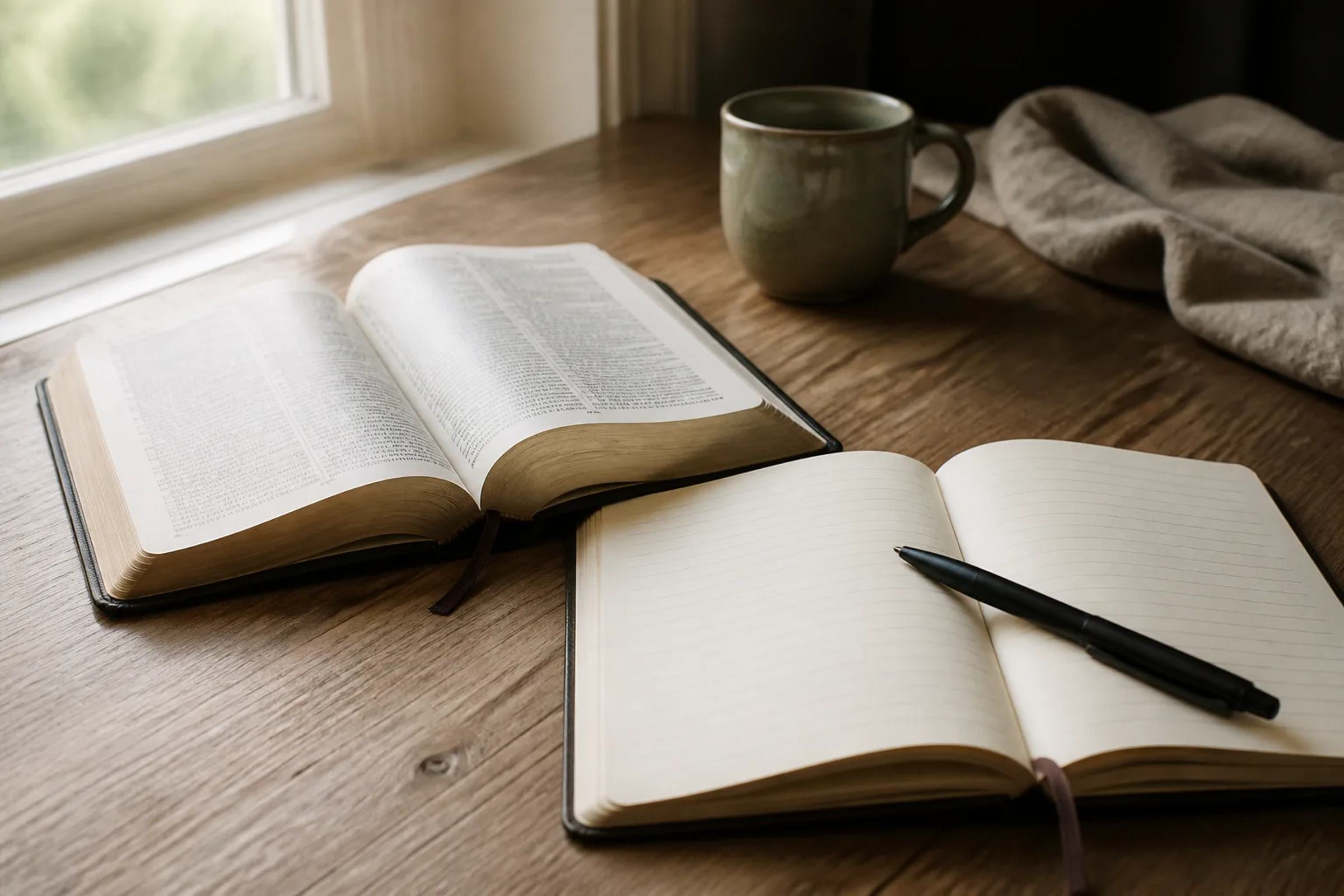
- Sit with one honest question. You may want to keep a journal nearby.
- Pray. Use the psalm's own words, or a short prayer drawn from them, and make the words your own.
- End the way you began—in silence.
Your mind will wander. Everyone's does. When it happens, go back to the line that caught you and read it again. Some days the words will feel like your own. Other days you'll pray them on faith. Both count.
Don't rush. Nothing here is graded. The goal isn't to finish a reading plan. It's to meet a Person—the Shepherd who has been waiting for you beside still waters all along.
Ten psalms, ten postures of prayer
The Psalms don't only give you words. They teach you postures—ways of coming before God. Here are ten, with one psalm for each.
- Listening — Psalm 1. Prayer starts with God's word, not ours. Begin by hearing the God who has already spoken.
- Trusting — Psalm 23. “The Lord is my shepherd; I shall not want.” He leads you, restores you, provides for you, and walks with you through the valley.
- Lamenting — Psalm 13. “How long, O Lord?” You can hurt out loud. Don't try to clean up your feelings before you pray.
- Resting — Psalm 127. “He gives to his beloved sleep.” You are not the one holding it all together. Rest is an act of trust.
- Blessing — Psalm 67. “May God be gracious to us and bless us.” We are blessed to be a blessing, so that God's way may be known on earth.
- Waiting — Psalm 130. “My soul waits for the Lord more than watchmen for the morning.” Waiting can be watching, with your eyes on the horizon.
- Asking — Psalm 17. “I call upon you, for you will answer me, O God.” He hears. He answers. He moves.
- Confessing — Psalm 32. “Blessed is the one whose transgression is forgiven.” Confession is the way out from under guilt and into a clean slate.
- Quieting — Psalm 131. “I have calmed and quieted my soul, like a weaned child with its mother.” You don't need every answer to trust the One who has them.
- Wondering — Psalm 8. “What is man that you are mindful of him?” The God who made the stars has set His love on you.
Taken together, these ten trace the full landscape of a life lived with God—green pastures and dark valleys alike. You don't have to master them all at once. Pray one a day.
Start with ten days
If you'd like a guide for the first ten days, Still Waters walks you through these ten psalms in exactly this way. Each day gives you one psalm, a short reflection, a question to consider, and a prayer you can actually pray—ten minutes from the first silence to the last. Day One is already on the blog: Begin with the Word.
Read one a day for ten days, and watch what God does.
Adapted in part from Still Waters: Learning to Pray with the Psalms, written by The Ancient Path staff writer Chris Pappalardo.
Questions
Questions about praying the Psalms
How long should I spend praying a psalm each day?
Ten unhurried minutes is enough to start: two minutes of silence, a slow reading of one psalm, a short reflection and question, a prayer, and two minutes of silence to finish.
Which psalm should I start with?
Start where the book of Psalms starts, with Psalm 1. It teaches the first posture of prayer: listening to the God who has already spoken.
Is it okay to pray the sad or angry psalms?
Yes. There are more psalms of lament than any other kind. God invites honest prayer, and the psalms of lament give you words for it when you have none of your own.
What if my mind keeps wandering?
That's normal. When it happens, go back to the line that caught you and read it again. Nothing here is graded.
Still Waters — free, from The Ancient Path
Overwhelmed? Read 10 Psalms in 10 days.
Still Waters walks through ten psalms just like this: one psalm, a short reflection, and a prayer you can actually pray, every day for ten days. Ten minutes a day. Enter your email and start right now. Find rest for your soul.
And if you know someone who needs it, send it to them.